 zfn9
Anthropic's Public Benefit Fund: What Its 5% Share Pledge Means
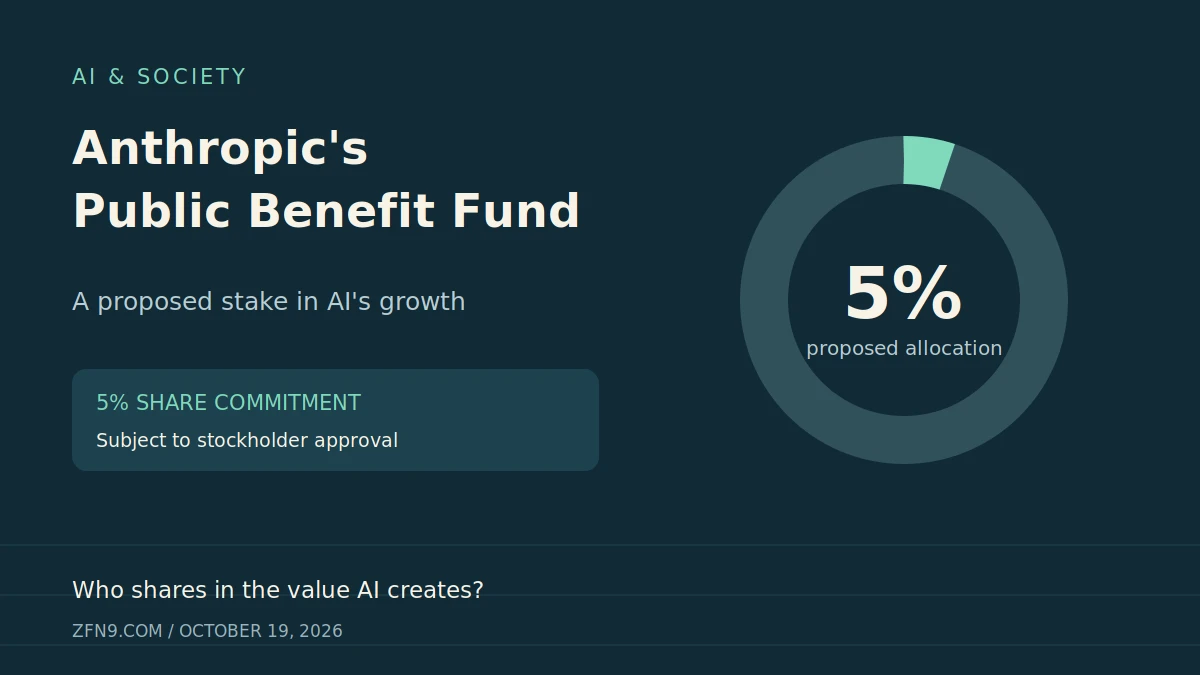
On October 18, 2026, Anthropic announced a Public Benefit Fund backed by a proposed 5% allocation of its shares, subject to stockholder approval. The board could add another 2% for each 50% increase in company value above a baseline. Those increases would be discretionary. Source: Anthropic’s announcement.
For people following AI’s economic impact, the interesting question is how a stake in a growing AI company could translate into useful support for workers and communities. This article separates the announced terms from our analysis of what would make the proposal effective.
What Anthropic has announced
The fund would be a wholly owned LLC. Anthropic says it could support nonprofit donations or direct distributions to particular populations, and that its equity would not fund lobbying or political giving.
The company puts its combined public-good equity commitments at roughly 20%, including earlier founder and employee pledges. That figure describes several commitments together; the proposed new allocation is 5%. Governance details and valuation milestones are due in the coming months. Source: fund structure and commitments.
How this differs from the $200 million research fund
Anthropic’s separate Economic Futures Research Fund has a $200 million commitment for external research. Its July 22 agenda covers workplace practices, career transitions, income support, worker participation in AI-driven growth, and public investment. It seeks evidence through experiments, pilots, and program evaluations. Source: research fund agenda.
That distinction matters when reading the news. Research funding can test whether an intervention works. An equity-backed public benefit vehicle could potentially help finance broader action. Evidence and delivery serve different purposes, and a successful approach would need both.
The research agenda includes testing retraining and job placement, income support, and mechanisms that give workers a stake in economic gains. These are proposed research directions, rather than demonstrated solutions to future AI disruption. Source: proposed interventions.
Our analysis: what would make the fund useful?
An equity commitment offers a way to connect a company’s success with resources for public benefit. But shares alone do not tell a prospective recipient when help will arrive or how much support will be available. Our assessment is that the next disclosures should make that path understandable.
Three questions would help readers judge the proposal:
| Question | Why it matters |
|---|---|
| How will shares become spendable resources? | A funding mechanism needs to connect an ownership stake with payments that recipients can use. |
| Who will select recipients and oversee decisions? | Published criteria and outside scrutiny would help people assess whether spending serves the stated purpose. |
| How will results be measured and reported? | Spending totals alone cannot show whether people’s employment, income, or access to services improved. |
For example, consider a hypothetical program for workers moving into a new occupation. A useful evaluation would track whether participants found suitable work, how their earnings changed, and whether the results lasted. Counting course enrollments would answer a narrower question.
Likewise, a hypothetical direct-payment pilot could examine income stability and household wellbeing alongside employment. Different programs would need different measures; publishing those measures before results arrive would make evaluation more credible.
What readers should watch next
The initial commitment remains subject to approval, and the October announcement leaves governance for later disclosure. Source: approval condition and next steps.
Our view is that the most useful follow-up will describe decision-making, a spending timetable, eligibility, and public reporting. Those details would let workers and community organizations assess whether a future program fits their needs.
The proposal gives readers a concrete way to examine a larger AI debate: who shares in the value the technology creates? Its practical value will become easier to judge when there is a visible route from company equity to funded programs and measurable outcomes.
Sources checked on October 19, 2026. Company commitments are attributed to Anthropic; assessments and hypothetical examples are editorial analysis.
Related articles

Lack of Agreement on AI Rules in U.S., EU Gives China a Leg Up

15 Best AI Tools for Startup Founders

How to Use AI Brand Voice Generator to Preserve Channel-Specific Voices

AWS Seeks to Teach Executives About Generative AI

Top 11 Companies Hiring for AI Jobs in 2025

12 Top Resources to Build an Ethical AI Framework

Orchestrating AI: the Transition From Solo Acts to a Complete Symphony

How AI Can Be Your HR Sidekick in Recruitment and Employee Engagement

How to Use AI Ad Generators to Create Personalized Ad Campaigns 5x Faster

AI Call Center Is No Longer a Myth but a Reality: 6 Steps for Painless Implementation

Lightweight Agno Framework for Fast Multimodal AI Agent Creation
12 Top Resources to Build an Ethical AI Framework
Latest articles

Giving Robots a Sense of Touch: Tactile Sensors Reach the Fingertips

BT Highlights the Crucial Role of Networks in AI at Mobile World Congress

The Beginner’s Guide to Building RDDs in Apache Spark with PySpark

SSH vs. Telnet: Key Differences in Cyber Security

How Amazon AppFlow Transforms Data Integration Across Cloud Services

AWS S3 Buckets and Security Explained: How Data Stays Safe in the Cloud

A Complete Guide to Apache Sqoop: Features, Architecture, and Operations

What Flipkart Reviews Reveal: A Deep Dive into Sentiment Analysis

How Data Warehousing in Azure SQL Simplifies Analytics Workloads

How Microsoft’s New AI Agents Are Redefining Factory Automation at Hannover Messe 2025

Getting Started with Exploratory Data Analysis in Einblick
